The Resilience Matrix: A Leadership Framework for Performing Under Pressure
When leaders talk about resilience, it’s often framed as a personal responsibility: manage your stress, build grit, bounce back faster. But anyone leading inside today’s organizations knows the truth is more complex.
Pressure isn’t just personal — it’s systemic.
Burnout doesn’t happen in isolation — it spreads.
And performance under stress is rarely about effort — it’s about design.
The Resilience Matrix is a leadership framework that helps individuals and organizations understand how humans respond under pressure, why those responses make sense, and how to recover in ways that restore clarity, capacity, and momentum — without self-erasure.
This is not a model for avoiding pressure.
It’s a model for leading well inside it.
Why Resilience Needs a Systems Lens
In most organizations, resilience conversations happen after things break:
People are exhausted
Decisions feel reactive
Change initiatives stall
Teams spin their wheels despite working harder
At that point, leaders often ask:
“What’s wrong with our people?”
The Resilience Matrix reframes the question:
“What state is this system operating in — and what does it need right now?”
Just like technical systems, human systems respond predictably under load. The problem isn’t that leaders or teams are failing — it’s that capacity, load, and recovery are out of balance.
The Resilience Matrix: Four States Under Pressure
The Resilience Matrix maps four natural human operating states that show up when pressure meets capacity. These are not personality types. They are temporary states of being — and every leader and team moves through all of them.
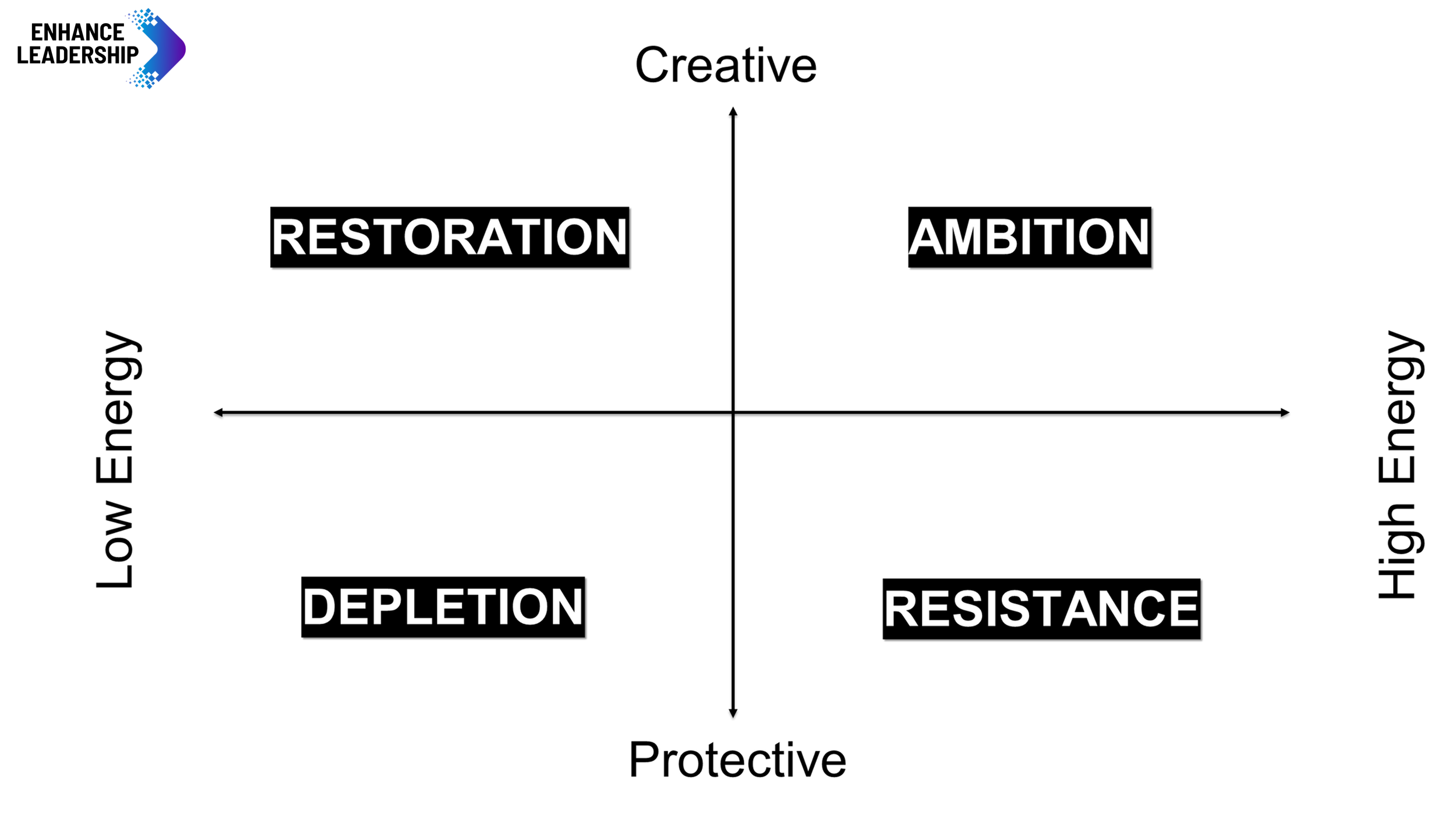
1. Depletion — Survival Mode
This state appears when load has exceeded capacity for too long.
What it looks like (individual):
Low energy, disengagement
Narrow thinking
Difficulty prioritizing or deciding
What it looks like (team/organization):
High absenteeism
Slow execution
Missed details
“We’re busy but nothing’s moving”
Key insight:
Depletion is not failure — it’s a signal.
If everyone on a team is in depletion, no amount of urgency will fix performance.
The system needs protection and capacity before progress is possible.
2. Resistance — Protective Energy
Resistance emerges when something feels unsafe, misaligned, or needs to stop.
What it looks like (individual):
Defensiveness
Frustration
Boundary enforcement
“This isn’t okay”
What it looks like (team/organization):
Conflict spikes
Pushback on change
Meetings feel tense
Decision paralysis
Key insight:
Resistance is an alarm system — and alarms are useful.
But when alarms run constantly, they drain the system and reduce trust.
3. Restoration — Rebuilding Capacity
Restoration focuses on recovery, recalibration, and preventative maintenance.
What it looks like (individual):
Pulling back
Reflection
Recharging energy
Regaining perspective
What it looks like (team/organization):
Pauses in execution
Learning moments
Reduced pace
Emphasis on wellbeing
Key insight:
Restoration prevents burnout — but if overused, it can stall momentum.
Recovery without re-entry leads to stagnation.
4. Ambition — Momentum & Innovation
Ambition fuels movement, creation, and progress.
What it looks like (individual):
Energy
Vision
Fast decisions
Risk-taking
What it looks like (team/organization):
Rapid execution
Innovation
Growth initiatives
High visibility
Key insight:
Ambition without integration leads to fragility.
Speed without reflection creates burnout downstream.
The Leadership Shift: From “Where Should We Be?” to “What Do We Need?”
The Resilience Matrix isn’t about staying in the “best” quadrant.
It’s about responding intelligently to the state you’re in.
For leaders, this creates a powerful reframe:
Burnout becomes data
Resistance becomes information
Slowness becomes diagnostic
Momentum becomes something to steward
This is where resilience becomes a leadership capability, not a wellness concept.
The Three Recovery Moves: How Leaders Navigate the Matrix
To move from awareness into action, the model uses three simple but powerful moves.
1. State Awareness (Diagnosis, Not Judgment)
Leaders ask:
Where am I right now?
Where is my team?
What’s the benefit of this state?
What’s the cost if we stay here?
This shifts leaders from self-criticism to systems thinking.
2. Antidotes: What This State Needs
Each state has an antidote — not to eliminate it, but to balance it.
Depletion → Protection
Reduce load, stop non-essential work, preserve energy.Resistance → Resourcing
Share the load, add support, lower constant threat.Restoration → Activation
Take one values-aligned step back into action.Ambition → Integration
Slow one decision, include more voices, metabolize learning.
This is how leaders prevent overuse of any single state.
3. Intentional Movement
Healthy movement between states happens when:
Load is redistributed
Capacity is restored
Energy is rebalanced
Movement is not about jumping quadrants — it’s about designing conditions that allow the system to rebalance naturally.
Zooming Out: What This Means for Teams and Organizations
One of the most powerful applications of the Resilience Matrix is team diagnosis.
Leaders can ask:
What state is our team operating in right now?
Are we asking depleted people to innovate?
Are we treating resistance as defiance instead of information?
Are we confusing activity with progress?
For example:
A team stuck in depletion needs fewer priorities — not more accountability.
A team in resistance needs clarity and resourcing — not pressure.
A team over-indexed on ambition needs integration — not another initiative.
When leaders fail to read these signals, organizations experience:
Change fatigue
Over-functioning leaders
Performative safety
Slow execution disguised as busyness
The Three Enabling Conditions
To raise capacity for you or your team, creating your own leadership system, we recommend the three enabling conditions that determine how resilient a leader or organization can become.
1. Awareness (Individual + Collective)
Self-regulation
Pattern recognition
Team sensing
Without awareness, leaders mistake reactivity for reality.
2. Capacity (Personal + Systemic)
Energy
Skill
Support
Role clarity
Without capacity, even the best intentions collapse.
3. Choice (Agency Under Pressure)
Behavioral flexibility
Decision latitude
Permission to pause, redirect, or stop
Without choice, leaders default to survival patterns.
These three conditions — Awareness, Capacity, Choice — are what allow movement through the matrix.
They also map cleanly to the first two pillars of Rebel Leadership.
Final Thought: Resilience Is a Leadership Advantage
Resilience isn’t about being tougher.
It’s about leading clearly when pressure is high.
Organizations that develop this capability:
Move faster with less friction
Make better decisions under stress
Retain talent
Build trust during change
Create leaders who don’t burn out — or burn others out
The Resilience Matrix offers leaders a way to stop reacting — and start designing how they perform under pressure.
Ready to Go Deeper?
If you want to explore how this framework applies to your leadership, your team, or your organization, stay connected. I share tools, insights, and opportunities to build resilience that lasts — without self-erasure.
Want more like this?
I share frameworks, reflections, and practical tools on leadership, resilience, and influence — especially for leaders and professional navigating pressure, visibility, and change.
Join my email list to learn how to apply these tools, find out about live trainings, and stay in the conversation.
